Introduction
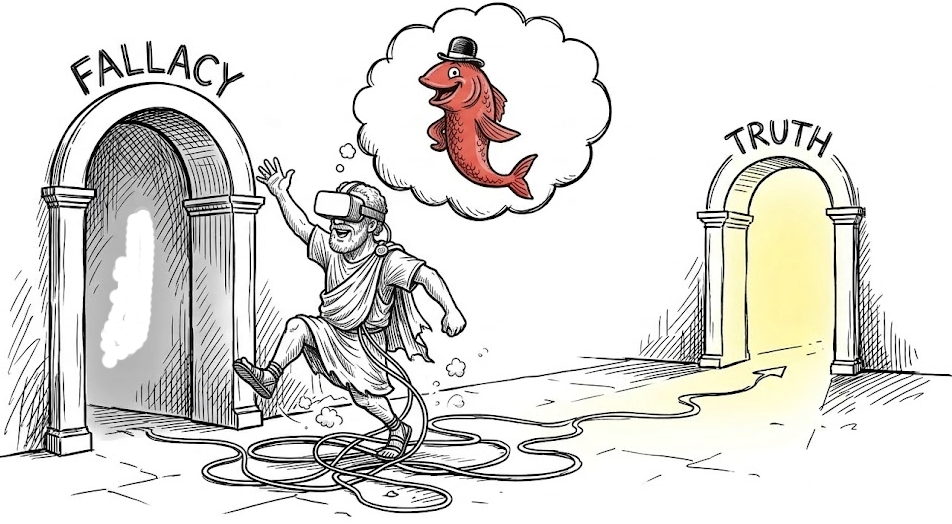
Spotting a fallacy is like finding a crack in a marble pillar. It doesn’t matter how beautiful the statue looks; if the base is flawed, the whole thing is coming down. In the noise of the modern world, fallacies are used as decoys to distract, intimidate, or trick you into building your life on a lie. Learning to see them isn’t just about winning arguments—it’s about protecting your own reason from the fog of manipulation. This is your field guide for the lab of reality.
Fallacies of Relevance
- Red Herring: Introducing an irrelevant topic to divert attention from the original issue. Example: “We shouldn’t worry about environmental policies when we’re facing economic challenges.”
- Appeal to Emotion: Using emotions to manipulate an audience instead of using valid reasoning. Example: “Think of the children! We must ban violent video games to protect them.”
- Appeal to Fear: Using fear to persuade rather than providing evidence. Example: “If we don’t pass this law, terrorists will take over our country.”
- Appeal to Pity: Attempting to win support by exploiting feelings of pity or guilt. Example: “You should give me a passing grade; I’ve been going through a really tough time lately.”
- Appeal to Spite: Dismissing a claim by exploiting existing bitterness or spite. Example: “Don’t support the new policy; remember how management treated us last year?”
- Appeal to Flattery: Using praise to manipulate someone into accepting a claim. Example: “A smart person like you surely agrees with my position on this issue.”
- Appeal to Force (Argumentum ad Baculum): Using threats or intimidation to persuade someone to accept a conclusion. Example: “Agree with the new company policy if you value your job.”
- Appeal to Consequences of Belief: Arguing that a belief is false because its implications are undesirable. Example: “Free will must exist; otherwise, we couldn’t hold people responsible for their actions.”
- Appeal to Authority: Accepting a claim as true simply because an authority figure states it, without considering evidence. Example: “This celebrity doctor says this diet cures all diseases, so it must work.”
- Appeal to Novelty: Asserting that something is better or more correct because it’s new or modern. Example: “This new diet must be the best because it’s the latest trend in nutrition.”
- Appeal to Tradition: Asserting that something is right or correct because it’s a long-standing tradition. Example: “We’ve always done it this way, so it must be the best method.”
- Appeal to Popular Beliefs (Bandwagon): Accepting an idea because many others believe it, rather than on its merits. Example: “Everyone’s investing in cryptocurrency, so it must be a good idea.”
- Appeal to Nature: Claiming something is good or right because it’s natural, or bad because it’s unnatural. Example: “Herbal supplements are safe because they’re all-natural.”
Fallacies of Personal Attack
- Ad Hominem & Personal Attack: Attacking the person making the argument instead of addressing their points. Example: “Dr. Smith’s research on climate change can’t be trusted because she takes private jets.”
- Tu Quoque: Deflecting criticism by pointing out similar behavior in the critic. Example: “You say I should quit smoking, but you used to smoke too!”
- Guilt by Association: Discrediting an idea because of their association with something undesirable. Example: “Jane’s argument can’t be trusted because she once worked for an oil company.”
- Poisoning the Well: Presenting negative information about someone before they speak to discredit them. Example: “Before we hear John’s opinion, remember he works for an oil company.”
- Genetic Fallacy: Evaluating an idea based on its origin rather than its merits. Example: “That health advice can’t be good because it came from a celebrity.”
Fallacies of Presumption and Misrepresentation
- Straw Man: Misrepresenting an opponent’s argument to make it easier to attack. Example: “Vegetarians want us all to starve!”
- Slippery Slope: Arguing that a small action will inevitably lead to extreme consequences without evidence.
- Black and White (False Dilemma): Presenting only two options when other alternatives exist. Example: “You’re either with us or against us.”
- Begging the Question: An argument where the conclusion is assumed in the premise. Example: “The Bible is true because it says so in the Bible.”
- Loaded Question: Phrasing a question to include an unjustified assumption. Example: “Have you stopped beating your wife?”
- No True Scotsman: Redefining a term to exclude counterexamples. Example: “No true Scotsman hates haggis.”
- Special Pleading (Moving the Goal Post): Making an exception to a rule when it doesn’t support your position.
- Nirvana Fallacy: Rejecting a solution because it isn’t perfect.
Fallacies of Ambiguity & Faulty Generalization
- Ambiguity: Using vague language to mislead.
- False Equivalence: Asserting two situations are equivalent while overlooking significant differences.
- Hasty Generalization: Making a broad claim based on insufficient evidence.
- Cherry Picking: Selectively choosing evidence that supports a position while ignoring contradictory data.
Fallacies of Faulty Causation & Lack of Evidence
- False Cause: Assuming a cause-effect relationship where only correlation exists. Example: “I wore my lucky socks and our team won.”
- Gambler’s Fallacy: Believing past random events affect the probability of future random events.
- Burden of Proof: Claiming something is true without evidence, then demanding others disprove it.
- Sunk Cost Fallacy: Continuing a behavior due to previously invested resources, despite new evidence.